


How to Customize Wedding Ceremony Music: A 2026 Guide

Table of Contents
Start With a Wedding Ceremony Music Timeline
Prelude and Guest Seating (30-45 Minutes Before)
Processional, Ceremony Rituals, and Recessional
Build Your Wedding Ceremony Song Checklist
Picking Wedding Processional Songs That Fit the Moment
Matching Tempo to the Walk
How Many Songs for a Wedding Ceremony?
Editing and Transitioning Your Tracks
Live Musicians vs. Recorded Tracks
Sound Check and Venue Acoustics in Sioux Falls
Match the Room Before You Match the Playlist
A Real Sound Check Protocol
Outdoor Ceremony Sound and Backup Plans
Conclusion
Frequently Asked Questions
Last Updated: October 8, 2026
Start With a Wedding Ceremony Music Timeline
Learning how to customize wedding ceremony music starts with one simple truth: the ceremony has a fixed order, and your songs have to follow it.
A wedding ceremony music timeline is the minute-by-minute plan that maps each song to a specific moment, from the first guest arriving to the final exit. It keeps your ceremony flowing and tells your sound team exactly what to play and when.
Here is the standard flow we use for Sioux Falls weddings:
Moment | Timing | Music Style |
Prelude | 30-45 min before | Soft background music |
Processional | Ceremony start | Instrumental, mid-tempo |
Ceremony rituals | During vows | Quiet or none |
Recessional | After the kiss | Upbeat, celebratory |
Prelude and Guest Seating (30-45 Minutes Before)
Prelude music is the background music that plays while guests arrive and find their seats. It sets the mood before anything official begins, so pick 8-10 soft instrumental or acoustic tracks and let them loop.
Keep the volume low enough that people can talk. Think gentle piano, acoustic guitar, or light strings. This is background music, not a concert.
Processional, Ceremony Rituals, and Recessional
The processional covers every entrance: grandparents, parents, the wedding party, and the bride or couple. Many couples use one song for the wedding party entrance and switch to a second, more emotional track for the main entrance.
The recessional is the song played right after the kiss as you walk back up the aisle. Pick something upbeat and short. You want energy, not a slow ballad.
Build Your Wedding Ceremony Song Checklist
A wedding ceremony song checklist is a single document that lists every song, its exact moment, and its start and stop points. It removes guesswork for your sound team and keeps everyone on the same page.
Build yours with these fields:
Song title and artist
Exact moment (prelude, processional, recessional)
Start point and stop point (timestamp)
Share this checklist with your officiant, your venue, and your sound team at least two weeks out. One master list beats five text messages.
Pro Tip Label each file with the moment, not the song name. "Processional_Bride.mp3" tells your sound engineer everything in one glance.
Picking Wedding Processional Songs That Fit the Moment
Wedding processional songs should match the pace and emotion of each entrance. The walk from the back of the aisle to the front takes about 20-30 seconds for a wedding party member and closer to a minute for the main entrance.
Choose based on the feeling you want, not just the lyrics. A song that works for a first dance often drags during a processional.
Matching Tempo to the Walk
Tempo is the speed of the song, measured in beats per minute. Match it to how fast people actually walk.
Slow walk (60-70 BPM): classic, formal, emotional
Mid-tempo (80-100 BPM): warm and steady
Upbeat (100+ BPM): joyful, modern, energetic
If the tempo is too fast, your wedding party will rush. If it is too slow, the walk feels endless. Test each song by walking it out at home.

How Many Songs for a Wedding Ceremony?
Most ceremonies need 10-14 songs total. That covers the prelude, all processional entrances, any ritual moments, and the recessional.
HMH Piano Collective
Break it down like this:
Prelude: 8-10 background tracks
Processional: 2-4 songs
Rituals (unity candle, sand, vows): 1-2 songs
You do not need a unique song for every single person. Grouping the wedding party under one track is common and keeps the ceremony moving.
Editing and Transitioning Your Tracks
Audio editing is the process of trimming, fading, converting, and level-matching your songs so they start and stop exactly when you need them.
Here is the workflow we recommend, with the reasoning behind each step.
Pick your files. Use high-quality MP3 (320 kbps) or WAV files, not YouTube rips. Compressed rips lose the high frequencies that make a processional feel bright, and they often carry a volume drop that is hard to fix later.
Trim the intro. Cut long intros so the song starts near the first verse. A 45-second ambient intro is fine on an album and deadly at a ceremony, your wedding party is already halfway down the aisle before the melody arrives.
Set your fade-in. A 2-3 second fade-in sounds smooth as someone begins walking. Anything shorter feels like a hard cut; anything longer feels like the music is late.
Set your fade-out. A 3-5 second fade-out ends a track without an abrupt cut. For a processional, time the fade to land as the walker reaches the front.
Level-match every track. This is the step most couples skip. Normalize each file to about -14 LUFS (the streaming-standard loudness) so a quiet acoustic track and a loud pop track play at the same perceived volume. Without this, your sound engineer is riding the fader all ceremony.
Convert if needed. Standardize all files to one format, MP3 320 kbps is fine for playback, WAV if your sound team asks for it. Mixed formats can cause a player to skip or stutter.
Label and export. Name each file by moment and save to one folder. Export a backup copy to a USB drive and to cloud storage.
Free tools like Audacity handle trimming, fading, and normalization. Paid audio software (Adobe Audition, Logic Pro) gives you cleaner fades, batch processing, and loudness metering if you have many tracks.
Pro Tip Build a 30-second "safety loop" of each processional track, a clean section you can loop if the walk runs long. If the bride pauses for a photo at the back of the aisle, your sound engineer loops instead of restarting the song.
Watch Out Never let a processional track run past the moment the person reaches the front. An awkward 30 seconds of music while everyone stands still kills the moment. Fade out, do not cut.
Live Musicians vs. Recorded Tracks
Before you spend a weekend in Audacity, decide whether you need to. For many Sioux Falls ceremonies, a hybrid works best.
Recorded tracks give you total control over song choice, exact timing, and cost. A curated playlist and a good PA can cover a 30-minute prelude, all processionals, and the recessional for a fraction of live-music pricing.
Live musicians (a string duo, solo guitarist, or harpist) add warmth and adapt in real time, they can stretch a processional if the walk runs long, and they read the room in a way a playlist cannot. The trade-off is cost, repertoire limits, and the need for a covered, powered setup outdoors.
The hybrid approach is what we see most often: live musicians for the prelude and processional, recorded tracks for the recessional and cocktail hour. This gives you the emotional weight of live performance at the moments guests are watching, and the flexibility of a playlist everywhere else.
If you go live, book 6-12 months out for peak Sioux Falls wedding season (May through October), and confirm the musician carries their own amplification or that your sound team can mic them.
Sound Check and Venue Acoustics in Sioux Falls
Venue acoustics are how sound behaves in a specific space, and they change everything about your ceremony audio.
This is the part most DIY guides skip.
Match the Room Before You Match the Playlist
Treat each Sioux Falls venue type differently:
Historic downtown halls (high ceilings, hard surfaces): Expect 1.5-2.5 seconds of natural reverb. Pull speakers in toward the guests, keep the master fader 3-6 dB lower than you would outdoors, and roll off below 100 Hz on the mixer to kill boom. Speech intelligibility drops fast in these rooms.
Modern hotel ballrooms (drop ceilings, carpet): Absorptive surfaces eat high frequencies. You will need 2-4 dB more presence in the 2-5 kHz range on the officiant mic so vows stay crisp.
Outdoor parks and prairie venues (no walls): There is no room to reinforce you, so every dB has to come from the PA. Aim speakers at the seating block, not the horizon, and expect to lose 6 dB of perceived level for every doubling of distance from the speaker.
A Real Sound Check Protocol
Run this at the venue, at the actual ceremony time of day, with the actual gear. Not the day before at noon if your ceremony is at 5 p.m., sun angle and ambient noise change.
Set up the PA at its final position. Speaker stands at ear height (about 5-6 feet) for seated guests, tilted down 5-10 degrees toward the back row.
Ring out the room. With the officiant mic live, slowly raise the gain until feedback starts, then back off 3 dB. That is your ceiling for the day.
Set the officiant mic. Aim for peaks around -12 dB on the mixer meter during normal speaking volume. That leaves headroom for a laugh or a loud "I do."
Walk the full aisle with a wireless mic. Note dead spots, usually behind pillars, near the back row, or beside a stone wall. Mark them on your checklist.
Play one processional track at show level. Walk the aisle yourself and confirm you can hear it clearly at the back row without it drowning out conversation at the front.
Test outdoor conditions. If the ceremony is outside, run the check with wind present. A foam windscreen on the mic and a 100 Hz high-pass filter on the mixer handle most of it.
Outdoor Ceremony Sound and Backup Plans
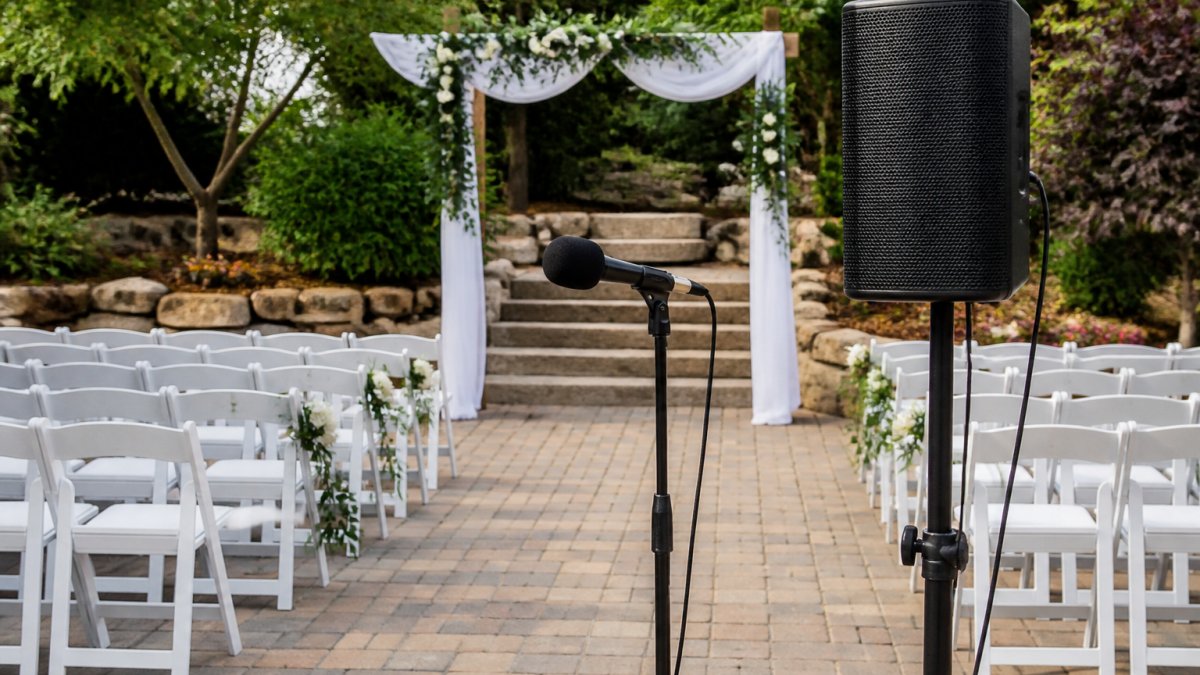
Outdoor weddings in South Dakota bring wind, open space, and unpredictable weather. Sound behaves differently outside, so you need a plan.
Use directional speakers pointed at guests, not the open field. A 90-degree coverage pattern is usually right for 100-150 guests.
Shield the mixing board from wind and direct sun. A black board in July sun can overheat and shut down mid-ceremony.
Bring a backup power source. A 1,000-watt inverter or a small generator covers a two-hour ceremony with a laptop, mixer, and one powered speaker.
Watch Out Never run a sound check for the first time on the wedding day. Book a 30-minute walkthrough with the venue at least a week out, and confirm the venue allows outside PA gear, some historic Sioux Falls properties require you to use their in-house system.
Every ceremony needs one person whose only job is music and sound. If that person is also your coordinator, your photographer, or your mom, something will get missed.
Conclusion
Customizing your ceremony music is one of the few wedding details you fully control, and it is worth getting right. If you would rather hand the technical side to people who do it every weekend, we can help. SD Wedding Pro offers ceremony sound, wireless microphones, professional DJ and MC services, and personalized planning for couples across Sioux Falls and southeastern South Dakota.
Frequently Asked Questions
How many songs do you need for a wedding ceremony?
Most ceremonies need 8 to 12 songs total. Plan for 4 to 6 prelude tracks while guests arrive, one processional for the wedding party, one bridal processional, one or two songs for rituals like a unity candle or sand pouring, and one recessional. If you have a long aisle or a large wedding party, add an extra processional track so nobody rushes.
Can you use nontraditional songs in a wedding ceremony?
Yes. Couples increasingly choose film scores, indie tracks, or instrumental covers of pop songs for wedding processional songs. The main considerations are tempo and length. A song that runs 2 minutes works for a short aisle walk, while a 4-minute track may need a fade-out. Your DJ or sound engineer can edit the track so it ends cleanly at the right moment.
How do you coordinate ceremony music with a DJ or live musicians?
Share a written wedding ceremony music timeline with exact cue points: when the officiant takes the microphone, when each processional starts, and when the recessional begins. If you are using live musicians alongside a DJ, schedule a sound check at the venue. In Sioux Falls, outdoor ceremonies near the river or in open parks need extra attention to wind and ambient noise.
What music should play while guests are arriving?
Prelude music sets the tone before the ceremony starts. Choose instrumental or low-key tracks at a moderate volume so guests can talk. Plan 30 to 45 minutes of prelude music with a fade-in as the first guests sit down. Avoid songs with heavy lyrics or sudden dynamic shifts. A wedding ceremony song checklist should list prelude tracks separately from processional and recessional picks.
Planning a ceremony soundtrack takes more moving parts than most couples expect: a timeline, a checklist, edited tracks, and a sound check that actually happens. SD Wedding Pro handles all of it with professional-grade audio systems, on-site engineers through our BlazerBox Live Sound partnership, and custom packages built around your venue and vision. Get started with SD Wedding Pro and walk into your ceremony knowing every note will land on cue.
Contact us today to check availability and request a quote

Comments