

Wedding DJ vs Band for Small Weddings: Sioux Falls Guide

Table of Contents
Why Small Weddings Change the Wedding DJ vs Band Decision
Wedding DJ Cost vs Band Cost: What Sioux Falls Couples Actually Pay
Realistic Sioux Falls Price Ranges
Why the All-In Number Matters More Than the Quote
The Small-Wedding Cost Lever Most Couples Miss
Atmosphere and Energy: Live Performance vs Recorded Music
Wedding Band Space Requirements and Venue Fit in Small Rooms
What Small Sioux Falls Venues Actually Constrain
The Small-Room Sound Trade-Off
How to Measure Before You Book
Song Selection, Requests, and Keeping the Dance Floor Full
Small Wedding Reception Entertainment Ideas That Work
Hybrid and Scaled-Down Options
Building a Wedding Reception Music Timeline
Frequently Asked Questions
Last Updated: October 21, 2026
Why Small Weddings Change the Wedding DJ vs Band Decision
Picture a 70-guest reception in a Sioux Falls venue with a 20-by-30-foot dance floor. A five-piece band would fill a third of it. That single math problem explains why the wedding DJ vs band question has a different answer for small weddings than it does for 200-guest events.
The pattern holds: the smaller the guest list, the more the room itself decides.
Small weddings change three things at once:
Space. Every square foot counts when the guest count is low.
Sound. A loud band overwhelms a small room; a DJ can dial volume to the crowd.
Budget. Fewer guests usually means a tighter total spend, and live music eats a bigger share of it.
Below, we break down real cost structures, venue fit, and the hybrid options most couples never hear about.
Wedding DJ Cost vs Band Cost: What Sioux Falls Couples Actually Pay
A wedding DJ typically costs less than a live band for a small reception, and the gap is widest at the low end. The reason is simple: you pay per musician with a band, and a small Sioux Falls room rarely needs six of them.
But the headline quote is not the number that matters. The number that matters is the all-in cost, travel, overtime, ceremony audio, lighting, and the breaks a band takes that a DJ does not.
Realistic Sioux Falls Price Ranges
These are the ranges we see quoted for small receptions in the Sioux Falls area, not national averages. Treat them as planning bands, not bids, every vendor prices differently, and a venue 60 miles out of town changes the math.
Cost Factor | Wedding DJ (small reception) | Live Band (small reception) |
Base performance fee | $700-$1,500 | $2,000-$5,000 |
Ceremony audio add-on | $150-$400 | $250-$600 |
Uplighting / dance-floor lighting | $200-$600 (often bundled) | $300-$800 (usually separate) |
Travel beyond Sioux Falls metro | $0-$150 | $150-$500 (more people, more gear) |
Overtime (per hour) | $100-$250 | $250-$500 |
Emcee / announcements | Usually included | Sometimes included, often extra |
Breaks | None, music continues | Band needs 15-20 minute set breaks |
A common pattern in the Sioux Falls market: a DJ package that includes ceremony sound, wireless mics, uplighting, and emcee service lands in the $1,200-$2,200 range all-in. A four- to six-piece band with comparable coverage often lands at $3,000-$6,000 all-in once travel, lighting, and ceremony audio are added.
Why the All-In Number Matters More Than the Quote
A cheap quote that excludes ceremony audio, wireless microphones, and uplighting rarely stays cheap. Ask every vendor for a line-item quote, not a lump sum. When the extras are itemized, you can see exactly where a band's price climbs and where a DJ package already covers the basics.
The small-wedding twist: because your guest count is low, you are not paying for a bigger room or a bigger crowd, you are paying for coverage. A 60-guest wedding still needs ceremony audio, toasts on a wireless mic, and dance-floor lighting.
Pro TipAsk every vendor for a line-item quote, not a lump sum. When the extras are itemized, you can see exactly where a band's price climbs and where a DJ package already covers the basics.
Watch OutBeware the "starting at" price. In the Sioux Falls market, a band's advertised starting rate often assumes a local venue, no ceremony audio, and no lighting. Add those three and the number can climb by a third or more.
The Small-Wedding Cost Lever Most Couples Miss
With fewer guests, you have more room to negotiate scope rather than price. A trio instead of a quintet, a DJ plus a single live instrumentalist for key moments, or a shorter band set focused on the dancing hours, each of these trims cost without gutting the experience. Ask vendors what a scaled-down version of their standard package looks like for your guest count. Many will quote it, and few couples think to ask.
Atmosphere and Energy: Live Performance vs Recorded Music
Live music creates a moment. A DJ creates momentum. That is the honest trade-off, and small weddings feel it more sharply than large ones.

A band delivers a shared spectacle. Guests gather to watch, and the room feels bigger than it is.
A DJ keeps a continuous thread. Songs blend, requests land in real time, and the emcee steers the room between toasts and dances.
Live performance wins when your crowd loves watching musicians. Recorded music wins when you want the floor full from first dance to last call.
Watch OutBooking a full band for a room that seats 80 often backfires. The volume forces guests to shout, older relatives leave early, and the dance floor shrinks to the front row.
Wedding Band Space Requirements and Venue Fit in Small Rooms
Wedding band space requirements are the most overlooked line in the planning spreadsheet. In a 20-by-30-foot dance floor, a common size in small Sioux Falls reception rooms, that footprint is the difference between a dance floor and a stage.
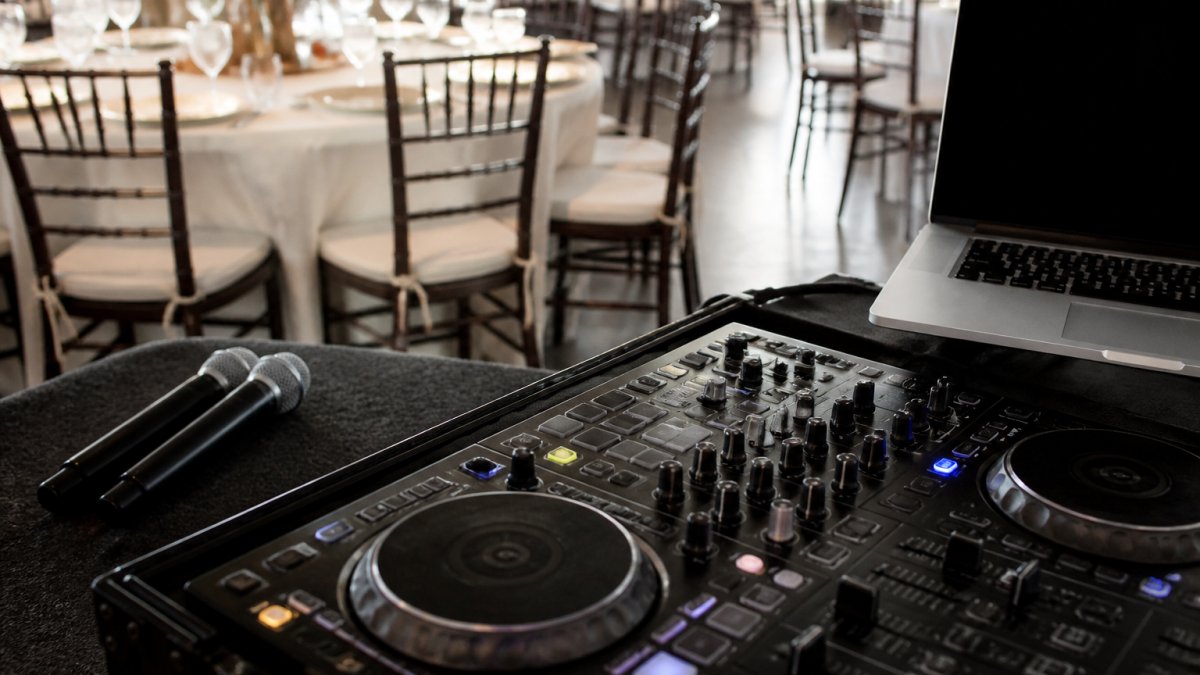
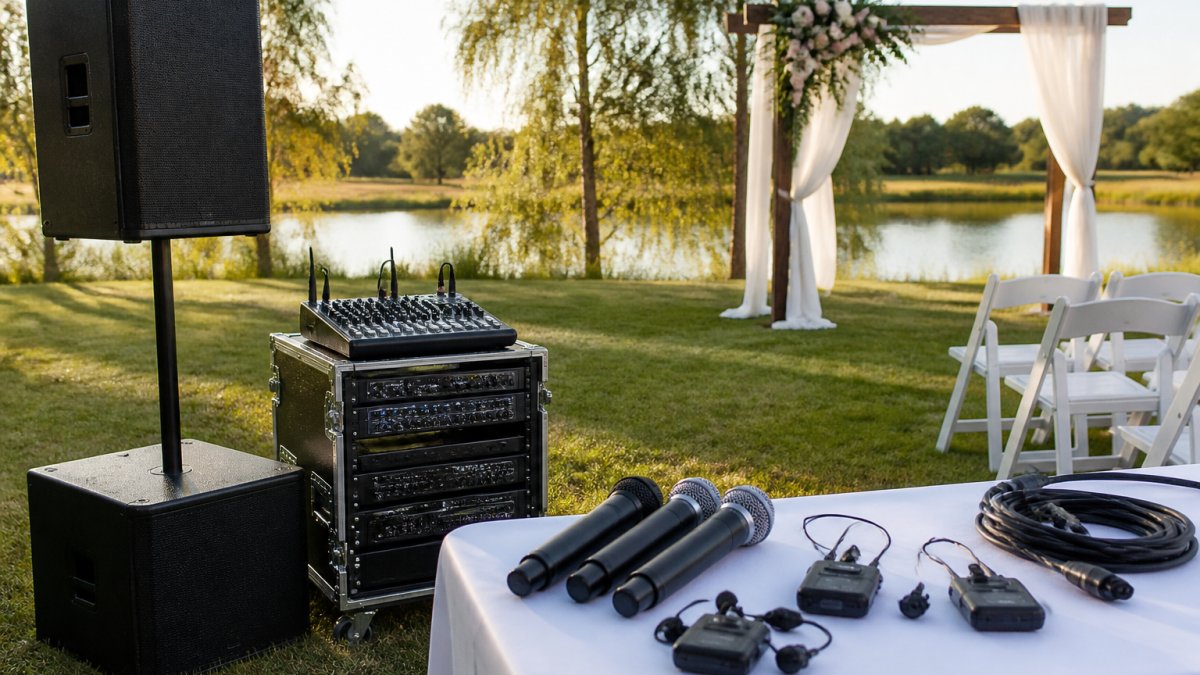
A DJ setup fits in a fraction of that: a six- to eight-foot table, two speakers on stands, and a light stand. In a small Sioux Falls venue, that recovered floor space becomes seating or dancing.
What Small Sioux Falls Venues Actually Constrain
The venue-fit question is not abstract. Different venue types in and around Sioux Falls impose different limits, and the answers change which option fits.
Historic downtown buildings. Tight load-in routes, shared walls, and older electrical panels. A drum kit's volume carries through shared walls in a way a DJ's controlled PA does not. Ask about load-in door width and whether the room has a freight entrance.
Hotel ballrooms. Usually generous power and load-in, but often have sound limits or a hard curfew tied to neighboring guest rooms. A band's volume ceiling is harder to manage than a DJ's.
Outdoor and tented venues. Power is the constraint. A band's amp and monitor draw can require a generator or a dedicated circuit; a DJ setup is lighter. Wind and open air also swallow sound, which favors a DJ's ability to push volume cleanly.
Wineries and event barns in the surrounding region. Charming acoustics, unpredictable power, and often a noise ordinance or neighbor agreement that sets a hard outdoor cutoff.
Ask these questions before you book either option:
Where does the power come from, and how many dedicated circuits are available?
Are there noise limits or hard curfews set by the venue or the city?
Can equipment load in through a standard door, or is there a freight route?
Will the setup block a fire exit or the catering path?
Is there a house sound system, and does the venue require you to use it?
The Small-Room Sound Trade-Off
Sound is the second half of venue fit, and it is where small rooms punish the wrong choice. A loud band overwhelms a small room; a DJ can dial volume to the crowd.
A DJ can hold a comfortable volume for conversation and still fill the dance floor when the moment calls for it. That control is the mechanism, not a slogan: the DJ rides the volume up for open dancing and down for dinner and toasts, all night, without a set break.
How to Measure Before You Book
Before you commit, walk the room with a tape measure and your vendor's footprint in hand. Mark the band's or DJ's footprint on the floor with painter's tape. Then mark the dance floor. If the two overlap, you have your answer, either scale down the entertainment or rethink the room layout. This five-minute exercise prevents the most common small-wedding entertainment regret, and almost no couple does it.
Song Selection, Requests, and Keeping the Dance Floor Full
Song choice decides whether the dance floor fills. A DJ carries a deep music library and can read the room in real time, swapping a track the moment the floor thins.
A band plays a fixed set list. That set is rehearsed and polished, but requests rarely land mid-show. If your must-play list includes specific songs for the first dance or parent dances, confirm the band can actually perform them.
What most guides miss is the emcee role. Announcements, toasts, and the bouquet toss need a confident voice on the microphone. A dedicated DJ-emcee handles it all night.
A practical approach for small weddings:
Build a must-play list of 10 to 15 songs.
Add a do-not-play list so nothing kills the mood.
Leave the rest to the professional reading the room.
Key TakeawayThe best dance floor comes from trust, not a 200-song spreadsheet. Give your vendor clear guardrails, then let them work the crowd.
Small Wedding Reception Entertainment Ideas That Work
Small wedding reception entertainment ideas should match the room, not fight it. With fewer guests, one good decision moves the whole night.
Consider these options:
Acoustic cocktail hour. A solo guitarist or duo sets a warm tone while guests mingle.
DJ plus live musician. A DJ runs the reception while a saxophonist or vocalist joins for key moments.
Curated playlist with a pro emcee. Lower cost, but you still get clean sound and confident announcements.
Photo booth or lawn games. Give non-dancers something to do during band breaks.
Hybrid and Scaled-Down Options
The band-and-DJ package is the smartest middle path for small weddings. A duo or trio plays the ceremony and cocktail hour, then a DJ takes over the reception. You get live music's warmth without paying for a full band all night.
Scaled-down bands work too. A trio costs less than a six-piece, fits a small stage, and still delivers a live feel.
Building a Wedding Reception Music Timeline
A wedding reception music timeline keeps the night moving. Most small receptions run four to five hours, and music should shift with each phase.
Here is a structure to consider:
Time | Moment | Music Style |
First 30 min | Guest arrival | Soft background |
30-60 min | Cocktail hour | Acoustic or light jazz |
Hour 2 | Grand entrance and first dance | Your chosen songs |
Hour 2-3 | Dinner and toasts | Low-volume classics |
Hour 3-4 | Open dancing | High-energy hits |
Final 30 min | Last call | Crowd favorites |
Build the timeline with your vendor, not for them. Share it with your planner and venue so everyone works from the same script. If you are searching for wedding entertainment near me in the Sioux Falls area, ask whether the vendor coordinates directly with your other vendors.
Frequently Asked Questions
Is a live band more expensive than a DJ for a small wedding?
Yes, usually. A live band typically costs more because you are paying multiple musicians, plus travel and equipment for the whole group. A wedding DJ cost vs band cost comparison for a small Sioux Falls wedding often shows a DJ running a fraction of a band's total. Request a quote from SD Wedding Pro to see how a DJ package fits your budget.
Can you have a band and a DJ at your wedding?
You can, and many couples do. A common setup is live music for cocktail hour or the first dance set, then a DJ handling the rest of the reception. This hybrid approach gives you the energy of live performance without paying a band for the entire night. It also solves the wedding band space requirements problem in smaller venues, because the band only needs room for a short set. Coordinate the handoff in your wedding reception music timeline so transitions stay smooth.
How much space does a wedding band need compared with a DJ?
A full wedding band often needs a stage or floor area roughly 12 by 16 feet or more, plus room for amps, drums, and monitors. A DJ setup usually fits in a fraction of that, often 6 by 8 feet. In a small Sioux Falls venue, that difference can decide whether a dance floor fits at all. Wedding band space requirements also include power needs and sound levels that may not suit an intimate room.
Is a DJ or live band better for a small wedding?
A live band brings a unique energy that some couples love, but it works best when the venue has room and the guest list is large enough to fill a dance floor. Weigh your venue size, budget, and how much you value live performance before deciding.
Planning a small wedding means every vendor choice carries more weight, and entertainment is no exception. SD Wedding Pro helps Sioux Falls couples match the right sound to the right room, with professional DJ and emcee services, ceremony audio, wireless microphones, dance-floor lighting, and uplighting backed by the audio team at BlazerBox Live Sound. Tell us your guest count and venue, and we will build a package that fits the space. Contact us today to check availability and request a quote.
Contact us today to check availability and request a quote
Comments